


Walk into any pharmacy or scroll through wellness content online, and you'll quickly notice that perimenopause supplements have become their own booming category. There are blends promising to tame hot flushes, capsules claiming to rescue your sleep, and powders supposedly designed to "balance your hormones." Most of them cost a lot. Most of them come with bold claims. And most of them are backed by far less science than their packaging suggests.
Here's the thing: some supplements genuinely can support you through perimenopause. But finding them requires more than reading the front of a label or trusting a trending ingredient. It requires knowing which questions to ask, and being willing to follow the evidence rather than the marketing.
That's exactly what this piece will help you do. We'll walk through why so many perimenopause supplements fall short, lay out a practical four-question framework for evaluating anything before you buy it, and then put common ingredients through that same test. No hype, no ingredient listicles. Just a clearer, more confident way to decide what's actually worth your money.
When the Supplement Aisle Feels as Overwhelming as Perimenopause Itself
You're already exhausted. You're waking in the early hours with your brain running at full speed, feeling like a stranger in your own body, and carrying the kind of tiredness that sleep doesn't seem to fix. Then you walk into a pharmacy or open a browser, and you're faced with dozens of products, all promising to be the answer.
The perimenopause supplement market has genuinely expanded, from a handful of capsule formulas into menopause-branded chocolate, shampoo and lifestyle products, many with little or no meaningful evidence behind them. The packaging is sophisticated. The claims are confident. The price tags suggest something premium and transformative is inside.
This growth reflects something real. Women in their late 30s and 40s are increasingly aware of perimenopause, actively looking for support, and far less willing to be dismissed than previous generations. That awareness is a good thing. But it's moved faster than the science, and the result is a market where consumer demand has outpaced scientific validation, a gap marketing has been happy to fill.
The problem isn't supplements as a category. Some are genuinely worth taking. The problem is that nothing in the way these products are sold helps you tell the useful ones from the expensive placebos. They all use similar language. They all make similar claims. Without a way to evaluate what's actually inside, you're essentially guessing.
This piece is not another ingredient list. It's a framework for asking sharper questions before you spend your money, so choosing feels less like a gamble and more like a genuinely informed decision. Supplements work best alongside the fundamentals, and this guide will help you understand exactly where they fit.
Why Most Perimenopause Supplements Fall Short of Their Claims
Part of the problem is structural. In the UK, food supplements are regulated as foods, under the Food Standards Agency, not as medicines. A brand can bring a perimenopause supplement to market without proving it works. It needs to be safe, correctly labelled, and its claims need to stay within the UK's nutrition and health claims rules, describing what a nutrient contributes to, not treating or curing a condition. If a product's claims cross into treating or preventing a disease, that tips it into medicinal territory and the MHRA's remit. In practice, that line is easy to blur, and marketing claims routinely outrun the evidence behind them.
The research behind most products compounds this problem. The gold standard for clinical evidence is a large, randomised, double-blind, placebo-controlled trial with meaningful follow-up. Most perimenopause supplement studies fall well short of that bar: they tend to be small, run for only a few weeks, and lack proper placebo controls. That matters because symptoms like hot flushes and disrupted sleep can respond strongly to placebo, with placebo improvement rates in vasomotor symptom trials ranging from 20% to 66%. Without proper controls, there's no reliable way to separate a genuine effect from wishful thinking.
Black cohosh illustrates this clearly. Some trials found it no more effective than placebo for hot flushes; others reported more favourable results. The difference tracks closely with study design: longer, blinded, placebo-controlled trials tend to show weaker effects, while shorter, open-label designs produce more favourable numbers. The ingredient didn't change; the rigour did.
The Menopause Society's 2023 nonhormone therapy position statement, a review of the evidence for non-hormonal approaches to vasomotor symptoms, does not recommend soy foods and extracts, evening primrose oil or wild yam cream for treating hot flushes, citing limited or inconsistent evidence. These are among the most heavily marketed perimenopause ingredients. NICE's own guideline similarly advises that people considering complementary therapies for menopause symptoms should be told that the safety, quality and purity of ingredients in unregulated preparations may be unknown.
There's one more issue worth naming. In a review of the evidence on botanical and dietary supplements for menopausal symptoms, researchers noted that around 70% of women using them do not tell their healthcare provider. That silence creates real risk, both from potential interactions with other medications and from delaying access to treatments with a stronger evidence base.
None of this means supplements are worthless. It means the marketing is ahead of the science, and some products deserve far more scrutiny than others.
The Four Questions Worth Asking Before You Buy Any Perimenopause Supplement
So, sharper questions it is. Here are four worth making a habit of.
Think of them as a filter, not a formula. The goal isn't to turn supplement shopping into a research project. It's simply to give you enough clarity to spot the difference between a product built on evidence and one built on marketing.
The four criteria are: ingredient form and bioavailability, dose adequacy, research quality, and symptom-specificity matching.
Each one matters independently, but they matter most together. A well-studied ingredient at the wrong dose does very little. The right dose in a poorly absorbed form is money down the drain. And even a well-formulated product with solid research behind it is unlikely to help if it was designed for someone with different symptoms to yours. All four have to line up.
This framework works whether you're considering a single-ingredient supplement or a multi-ingredient blend. The questions don't change; only the number of times you need to ask them does.
Question One: Is the Ingredient in a Form Your Body Can Actually Use?
Start here: the form of an ingredient is not a technicality. It can be the difference between a supplement that does something and one that largely passes through you.
Bioavailability means how much of a nutrient your body can actually absorb and use. Two products can list the same ingredient at the same dose and behave quite differently in your body, because the chemical form affects how well your gut can take it up.
Magnesium is a clear example. Magnesium oxide is cheap to manufacture, so it appears in many supplements, but it's poorly absorbed compared with organic forms and can cause digestive discomfort. Magnesium glycinate and magnesium bisglycinate tend to be better absorbed and gentler on the gut. A 2021 systematic review published in Nutrition found that organic magnesium forms are generally more bioavailable than inorganic ones, though it also noted that absorption is dose-dependent and evidence quality varies across studies.
Vitamin D is another fairly straightforward one. D3 (cholecalciferol) tends to raise blood levels more effectively than D2 (ergocalciferol), yet budget supplements sometimes use D2 because it costs less. The form is on the label if you look for it.
Phytoestrogens are more nuanced. The research on soy isoflavones, for example, isn't simply about whether soy "works." It's specific to particular extract concentrations, doses, and even your gut microbiome, since only some women can convert soy isoflavones into the more active compound equol. Whole food sources and isolated extracts behave differently in the body, and results from one form don't automatically transfer to another. This is why "contains phytoestrogens" on its own tells you very little.
What to look for on a label:
- The specific compound name, not just the category (magnesium bisglycinate, not simply magnesium)
- Standardised botanical extracts with a percentage marker (such as "45% isoflavones")
- Forms that match those used in the research the brand cites
If a brand lists an ingredient without specifying its form, that's worth noticing. Transparent formulation isn't complicated; it just requires a brand to prioritise it.
Question Two: Is the Dose High Enough to Actually Do Anything?
Even if an ingredient is in the right form, it still needs to be present in a meaningful quantity. This is where many perimenopause supplements quietly fall apart.
There's a practice sometimes referred to informally as "pixie dusting": including an impressive-sounding ingredient on the label at a dose too small to plausibly do much. The ingredient appears on the front of pack; the dose stays buried in the small print. It looks like a comprehensive formula. It often isn't.
The most reliable way to spot underdosing is to compare the label dose against the dose used in published clinical trials for that specific outcome, not a rough approximation, but the actual trial dose for the actual result being claimed.
Here's a concrete UK example. The NHS recommends 10 micrograms (400 IU) of vitamin D daily for the general population, a baseline aimed at avoiding deficiency, not a therapeutic target. UK guidance for maintenance supplementation generally allows for higher intakes, and studies looking at bone and mood outcomes in perimenopausal and postmenopausal women commonly use higher doses than the general baseline. A multi-ingredient formula containing a fraction of that is unlikely to be doing the work the label implies.
Proprietary blends make this kind of verification difficult. When a label lists a "Women's Hormone Blend" with a combined weight but no individual quantities, you can't assess whether any single ingredient reaches a useful dose. That opacity isn't a sign of a sophisticated formula; it's a sign that the brand doesn't want you to check.
More ingredients doesn't mean more benefit. A formula listing twenty-plus nutrients at sub-clinical doses isn't a comprehensive solution. It's a marketing decision dressed as a formulation one. A shorter formula with fewer, well-dosed, evidence-matched ingredients will usually outperform it in practice.
Ask any brand you're considering: why was this dose chosen, and which trial supports it? If they can't answer clearly, that tells you something.
Question Three: What Does the Research Actually Show, and How Good Is It?
Even the right dose of the right ingredient can let you down if the research behind it doesn't hold up. So before taking any brand's evidence claims at face value, it helps to understand that not all research is equal.
Think of it as a ladder. At the bottom sit anecdotal reports and in-vitro studies (research done on cells in a lab). Observational studies sit a few rungs higher. At the top are large, randomised, double-blind, placebo-controlled trials with meaningful follow-up. Most supplement research sits closer to the bottom of that ladder than the top.
"Studies show" is doing very little work without context. When a brand cites evidence without specifying the study design, sample size, or trial length, that phrase is close to meaningless. A study of under 30 people over six weeks tells you something very different from a trial of hundreds of participants over six months.
Black cohosh is a useful example here too. The conflicting results across studies aren't random; they reflect real differences in extraction method, dose, duration, and whether participants were perimenopausal or postmenopausal, two physiologically distinct groups.
When you're looking at a brand's evidence page, it's worth watching for:
- Studies funded entirely by the supplement manufacturer
- Research conducted on postmenopausal rather than perimenopausal women
- Small sample sizes
- Short trial durations
- Citations that link to another brand's blog rather than a primary study
Ask yourself: is the actual research available to read? Does the study population resemble you?
The honest position is that a number of ingredients used in perimenopause supplements do have a reasonable evidence base. The issue is rarely that good evidence doesn't exist; it's that marketing rarely points you toward it.
Question Four: Does This Formula Match Your Actual Symptom Profile?
Even once you've checked the research quality, there's a fourth filter most women skip entirely: does this formula actually match what you're experiencing?
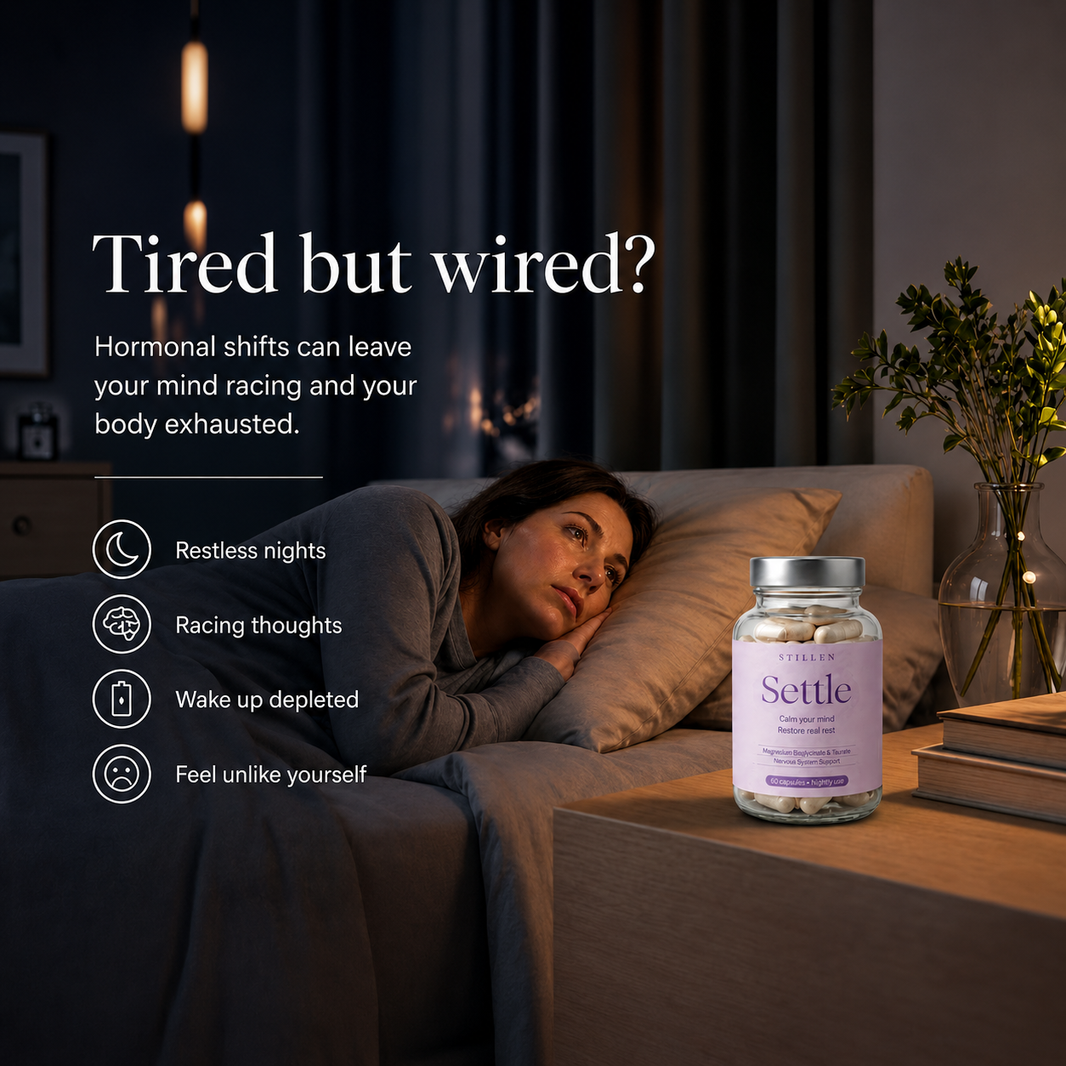
Perimenopause isn't a single, uniform experience. One woman is waking at 3am with a racing mind and dragging through her days feeling tired but wired. Another is struggling with brain fog so thick she's losing words mid-sentence. A third is noticing mood shifts, joint stiffness, or cycles that have become unpredictable. The evidence for different ingredients varies depending on which of these is your reality, and a formula built for vasomotor symptoms won't necessarily do anything for nervous system regulation, however well it's made.
The more useful approach is symptom-to-ingredient mapping. Before you search, write down your top two or three symptoms. Then evaluate ingredients against the evidence for those specific outcomes, not perimenopause in general.
A few examples of how that mapping works in practice:
If sleep disruption is your primary issue, magnesium in glycinate or bisglycinate form has some evidence for nervous system regulation, via its established role in normal nervous system function, and there's emerging, though still limited, research interest in the glycine component and sleep onset specifically. The evidence for magnesium and sleep quality itself is more mixed than marketing tends to suggest, so it's worth treating as a plausible support rather than a guaranteed fix.
If long-term bone health is a concern, vitamin D3 and vitamin K2 (as MK-7) are relevant, especially as oestrogen-related bone protection begins to shift during perimenopause. This is a gradual, preventative consideration rather than a symptom you'll notice immediately, but it's worth factoring in early.
If low mood and flagging energy are your main complaint, B vitamins, particularly B6, B9 and B12 in their active forms, support methylation and neurotransmitter production. Form matters here too: methylfolate rather than folic acid, methylcobalamin rather than cyanocobalamin. These distinctions are especially relevant for women with MTHFR gene variants, where conversion from synthetic forms is less efficient.
This is also where the "everything supplement" tends to fall apart. A product claiming to address hot flushes, brain fog, sleep, mood, libido, energy and weight in a single formula is almost certainly overpromising. Real formulation involves trade-offs; sedating and stimulating ingredients don't simply coexist peacefully at full dose. If a label reads like a symptom checklist, treat that as a signal, not a selling point.
The simplest protective habit: write your symptoms down before you open a browser. It stops marketing from doing the matching for you.
How Common Perimenopause Ingredients Hold Up Against the Framework
So let's apply the framework directly. Here's how some of the most commonly marketed perimenopause ingredients hold up.
Magnesium (glycinate or bisglycinate) sits among the better-supported options. It has an EFSA-authorised claim for contributing to the normal functioning of the nervous system, to normal psychological function, and to the reduction of tiredness and fatigue, and it's one of the more commonly under-consumed minerals in a typical Western diet, which strengthens the case for supplementing relative to many more heavily marketed ingredients.
Vitamin D3 is one of the more consistently justified supplements for UK women at this life stage. Evidence for bone health and immune function is well established. Evidence for a direct effect on mood is more emerging than settled, but given how little sunlight most of us get, deficiency is genuinely common. The form matters: D3 (cholecalciferol), not D2.
B vitamins in active forms are worth considering for energy and cognitive support. B6 has some evidence relevant to mood and PMS-adjacent symptoms; B12 and folate matter for methylation and neurotransmitter function. Active forms, methylcobalamin and methylfolate, tend to be better absorbed than their synthetic counterparts, particularly for women with MTHFR gene variants.
Black cohosh has genuinely conflicting evidence, as discussed above. If you're considering it, look for products using a standardised extract comparable to those used in the better-quality trials. The evidence base is strongest, though still mixed, for vasomotor symptoms; it's weaker again for mood or sleep.
Soy isoflavones and red clover are worth approaching carefully. The Menopause Society's 2023 position statement specifically does not recommend these for hot flush treatment, citing inconsistent evidence. Effectiveness may also depend on whether you're an "equol producer," a gut microbiome variable that determines how your body processes phytoestrogens; most supplement labels won't tell you that, because they can't.
Maca has some small studies suggesting modest benefit for energy and libido, but robust, high-quality human trial evidence isn't there yet.
Ashwagandha has some evidence for cortisol regulation and stress resilience, though most of the research is in general stress populations rather than perimenopausal women specifically. Given that chronic stress can worsen perimenopausal symptoms, it's mechanistically plausible, just not perimenopause-specific in its evidence base.
Evening primrose oil is one of the clearer ones to skip for hot flush relief. The Menopause Society does not recommend it for this use, and the evidence doesn't support the marketing claims commonly made for it.
Where Supplements Actually Fit: Alongside Support, Not Instead of It
Knowing which ingredients have a reasonable evidence base is genuinely useful. But it's only part of the picture, and context matters too.
If your symptoms are significantly affecting your quality of life, HRT remains the most established, evidence-backed treatment option for many women, and NICE's updated 2024 guidance continues to recommend it be offered for vasomotor symptoms. Supplements aren't an equivalent alternative, and any brand that implies otherwise is doing you a disservice.
That said, supplements do have a legitimate, more specific role. They're most useful for filling nutritional gaps that genuinely affect how you feel day to day. In the UK context, vitamin D and magnesium are the strongest examples: under-consumption of both is common, and adequate levels matter for bone health, nervous system function and general energy. These aren't glamorous selling points, but they're real ones.
One thing that doesn't get enough attention: if you're taking supplements alongside HRT or any other medication, your GP needs to know. As above, a large proportion of women using botanical supplements for menopausal symptoms don't disclose this to their healthcare provider, and some botanical ingredients can interact with medications in clinically significant ways.
It's also worth acknowledging that lifestyle foundations carry a stronger overall evidence base than most supplement ingredients. Sleep hygiene, resistance exercise, adequate protein, stress regulation and reducing alcohol all tend to outperform supplements in the research. If you're exploring options while waiting for HRT or deciding whether it's right for you, those foundations are a sensible place to start.
A well-chosen supplement from a transparent brand can genuinely support your toolkit. It works best when those foundations are already in place, not as a shortcut around them.
What a Supplement Brand Worth Trusting Actually Looks Like
So once you've decided a supplement is worth adding, how do you know which brand to trust?
Start with the label. A brand with nothing to hide tells you every ingredient, the specific form it's in, and the exact dose. If a product lists a "proprietary blend" with a single combined weight, you can't assess whether any individual ingredient is present at a meaningful dose. That opacity is a choice, and it's worth noting.
Next, look at the evidence they cite. Research links should point to peer-reviewed studies, not to a brand's own blog or a press release. Check that the studies actually match what's being claimed: the right form, the right dose, tested in a relevant population, measuring the outcome the brand is referencing. "Studies suggest," followed by a footnote to a mouse model, is not the same thing.
On language: in the UK, food supplements sit under the Food Standards Agency and the UK's nutrition and health claims rules, which allow brands to describe what a nutrient contributes to, not to claim it treats or cures a condition. If a claim strays into treating or preventing disease, that's the MHRA's territory, and a genuinely responsible brand stays well clear of that line rather than testing it. If a brand's marketing reads like a medical prescription, that's a red flag, not a selling point.
Perhaps most tellingly, a trustworthy brand is honest about what their product doesn't do. Scope statements matter. A brand willing to say "this is not a replacement for HRT, and it won't resolve every perimenopausal symptom" is demonstrating exactly the kind of integrity that justifies confidence in what they do claim.
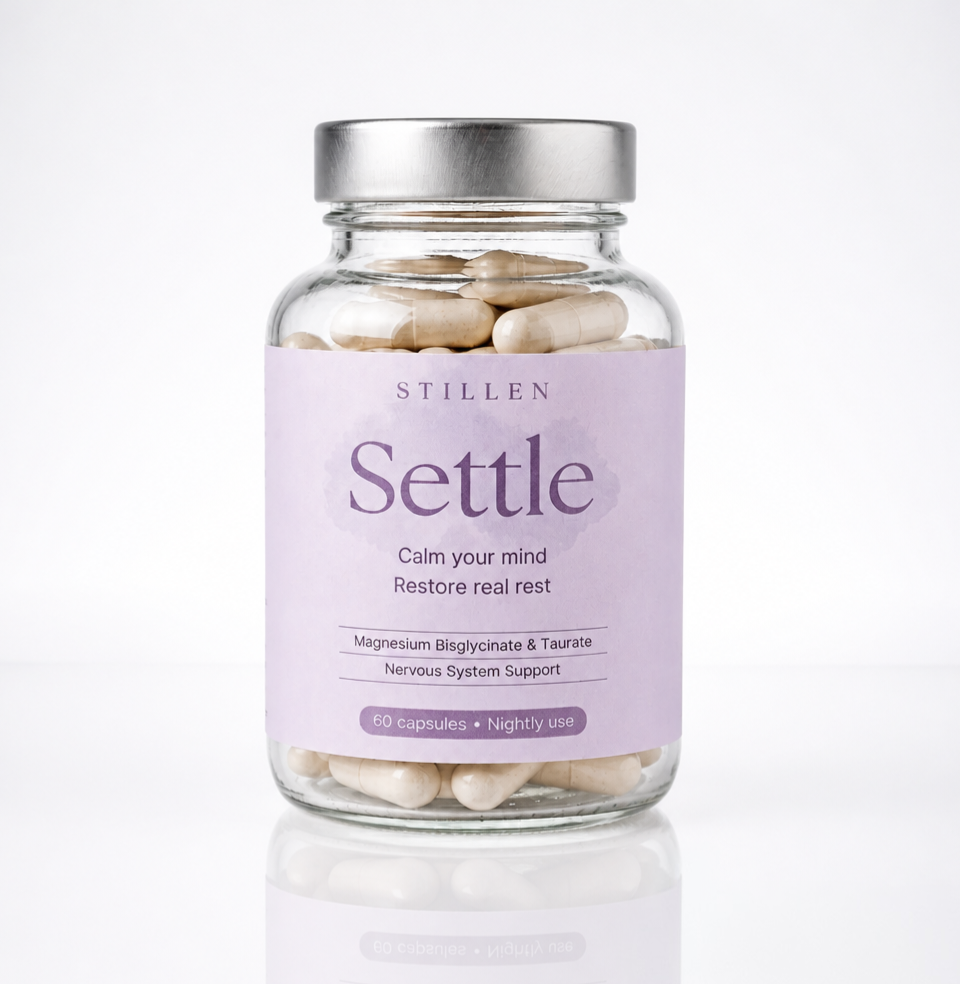
Stillen's Settle is formulated on this basis. It's a magnesium bisglycinate and taurate blend, chosen for their absorption profile, at a meaningful dose, intended for women who feel tired but wired during this stage. In line with its EFSA-authorised claims, magnesium contributes to the normal functioning of the nervous system, to normal psychological function, and to the reduction of tiredness and fatigue. It's positioned as one part of a broader approach to nervous system support, alongside sleep habits, movement and nutrition, not a treatment for perimenopause itself, and it says so plainly.
Choosing Supplements You Can Actually Trust
Once you know what good looks like, the choice genuinely gets easier.
Use these four questions as your quick-reference filter before you buy anything:
- What form is this ingredient in? Is it a form your body can actually absorb?
- Is the dose high enough to matter? Cross-reference it against the clinical trial evidence, not just the label.
- What does the research actually show, and how good is it? Look for the study design, not just the headline.
- Does this match my actual symptoms? Start with your experience, not the marketing copy.
That's it. Four questions. They won't take long once you've asked them a few times, and they'll save you from spending money on products that look impressive but deliver very little.
Yes, it takes slightly more effort than reaching for the most-advertised option. But that extra ten minutes means your money goes toward something with a genuine chance of helping, rather than a beautifully packaged promise.
Before you start anything new, it's worth a conversation with your GP or a menopause specialist, particularly if you're already taking medication. Some botanical supplements interact with other treatments, and your doctor needs the full picture to support you well.
The supplement aisle doesn't have to feel overwhelming. You're not choosing blindly between your symptoms and an exhausting wall of options. With the right criteria, the noise falls away, and what's actually worth your attention becomes much clearer.
The best supplement for you is the one genuinely formulated for you: the right ingredient, in the right form, at the right dose, for what you're actually experiencing. That standard exists, and you now know how to look for it.
Conclusion
Perimenopause is complex enough without wasting money on supplements that never had a real chance of helping. The framework in this post gives you what you need to cut through the noise: check that ingredients are bioavailable, confirm doses are in the range used in clinical research, evaluate the quality of that research, and match the formula to your specific symptoms.
No single supplement works for everyone, and none of them replaces proper medical support. But the right one, chosen with clear criteria, can make a genuine difference.
Your next step is simple. Pick up the supplement you're currently taking, or the one you're considering, and run it through those four questions. The answer will tell you quickly whether it deserves your money.
Frequently Asked Questions
Why do perimenopause supplements often fail to deliver on their promises?
Most perimenopause supplements fall short for three main reasons. First, in the UK, supplements are regulated as foods rather than medicines, so brands don't need to prove effectiveness before selling them; they need to be safe, correctly labelled and within the UK's health claims rules. Second, the research behind most products is limited, typically small studies run for only a few weeks without proper placebo controls. Third, symptoms like hot flushes and disrupted sleep can respond strongly to placebo, which makes it harder to separate a genuine effect from expectation. The gold standard, large, randomised, double-blind, placebo-controlled trials, is rarely used in supplement research.
What are the four key questions I should ask before buying any perimenopause supplement?
The four questions are: (1) Is the ingredient in a form your body can actually absorb? Check for specific compound names and standardised extracts. (2) Is the dose high enough to actually work? Compare it against clinical trial doses, not just the label. (3) What does the research actually show, and how rigorous is it? Look at study design, sample size and duration. (4) Does this formula match your actual symptoms? Choose supplements targeting your specific symptoms, not every perimenopausal issue at once.
Why is the form of a supplement ingredient more important than just the ingredient itself?
The chemical form affects bioavailability, how much of a nutrient your body can actually absorb and use. Magnesium oxide, for example, is cheap but poorly absorbed, while magnesium glycinate is generally better absorbed and gentler on the stomach. Vitamin D3 tends to raise blood levels more effectively than D2, and methylfolate is generally better absorbed than folic acid. Two products can list the same ingredient at the same dose but behave quite differently in your body depending on the form.
What is "pixie dusting" and how can I spot it on supplement labels?
It's an informal term for a practice where impressive-sounding ingredients appear on the label at doses too small to plausibly do much. The ingredient gets featured on the front of the pack while the small dose stays in the fine print, making the formula look comprehensive when it isn't. To spot it, compare the label dose against doses used in published clinical trials for that specific outcome; a fraction of the NHS's baseline vitamin D recommendation, for instance, is unlikely to be doing meaningful work in a multi-ingredient formula.
Are supplements a replacement for HRT if my symptoms are significantly affecting my quality of life?
No. HRT remains the most established, evidence-backed option for many women, and NICE's 2024 updated guidance continues to recommend it be offered for vasomotor symptoms. Supplements aren't an equivalent alternative. They do, however, have a legitimate role in filling specific nutritional gaps that affect daily wellbeing, such as vitamin D and magnesium, both commonly under-consumed in the UK and relevant to bone health, nervous system function and general energy. Always tell your GP about any supplements you're taking, since some botanical ingredients can interact with medications in clinically significant ways.
This article is for general information and does not replace individual medical advice. If you're considering starting a new supplement, particularly alongside other medication, please speak to your GP or a menopause specialist.
Sources referenced
- The Menopause Society, 2023 Nonhormone Therapy Position Statement
- NICE, Menopause: identification and management (NG23)
- Pardo MR, et al. Bioavailability of magnesium food supplements: A systematic review, Nutrition, 2021
- Geller SE, Studee L. Botanical and dietary supplements for menopausal symptoms: what works, what does not, Journal of Women's Health, 2005
- European Commission, Regulation (EU) No 432/2012, authorised EFSA health claims, including magnesium
- NHS, vitamins and minerals: vitamin D