



You wake up after what should have been a full night's sleep, and you still feel exhausted. Not just a little tired, but bone-tired, foggy, and wondering what on earth is happening to your body. If this sounds familiar, you are far from alone. Fatigue is one of the most common complaints women experience during perimenopause and menopause, and it sends many of us straight to the supplement aisle looking for answers.
The problem is that the supplement market is flooded with products promising to restore your energy overnight. Knowing which vitamins for menopause fatigue are actually worth your money, and which are mostly clever marketing, is genuinely difficult without a guide.
This post cuts through the noise. You will learn why menopausal fatigue feels so different from ordinary tiredness, what is actually driving it, and which specific nutrients have real evidence behind them. We will also cover what the research does not support as strongly, so you can make smarter decisions about where to focus your effort and spending. No overwhelm, just clarity.
Why Menopause Fatigue Feels Different From Ordinary Tiredness
There is a particular kind of exhaustion that arrives with perimenopause, and it is nothing like the tiredness you felt after a bad night or a stressful week. This is bone-deep. You sleep eight hours and wake feeling like you have not slept at all. You are running on empty before the day has even started.
And yet, somehow, your brain will not switch off.
That is the "tired but wired" paradox that so many women describe, and it is not simply a matter of overdoing it. Research shows that falling oestrogen and progesterone disrupt the brain's sleep architecture directly, meaning this isn't ordinary tiredness at a biological level. The nervous system stays in a low-grade alert state even when the body is desperate for rest. You are exhausted and restless at the same time.
What makes this particularly demoralising is the contrast. Women who previously prided themselves on energy, resilience, and getting things done suddenly find themselves struggling to get through a Tuesday. That gap between who you were and how you feel now is genuinely disorienting, and it deserves to be taken seriously.
The reason this fatigue is so hard to shift is that it rarely has a single cause. Poor sleep, changes in the body's stress-response system, shifting nutrient needs, and thyroid changes can all contribute, often simultaneously. The nutritional interventions that help depend on which of these drivers is doing the most damage.
That is the framework this piece uses. Rather than listing every supplement marketed as "energy support," it grades the evidence honestly, so you can focus your time and money on what is most likely to actually help you.
The Four Overlapping Drivers of Menopausal Fatigue
So what is actually driving that exhaustion? There are four distinct mechanisms, and they often overlap.
Poor sleep is the most obvious. As oestrogen falls, it disrupts the sleep architecture your brain relies on to restore itself. Night sweats can wake you repeatedly through the night, even when the sensation passes quickly, and lighter, more fragmented sleep means you rarely reach the deeper stages where real recovery happens. Do this for months or years, and the sleep debt compounds in ways a single good night cannot undo.
HPA axis dysregulation is less talked about but well-recognised in endocrinological literature. Your body's stress-response system is calibrated in part by sex hormones, so the shifting hormonal environment of perimenopause can leave women in a state of background physiological stress, burning energy the body does not have.
Nutrient depletion matters more than most women realise. Add a busy life where meals get skipped or simplified, and shortfalls in key micronutrients accumulate without obvious signs.
Thyroid changes are worth separating out specifically. Thyroid dysfunction shares several symptoms with menopause, fatigue, weight changes, feeling cold, and can coexist with it. This is not a nutritional issue; it requires a blood test and a conversation with your GP. For a broader overview of how these drivers connect, the Key Takeaways on menopause fatigue are worth reading alongside this.
Why does identifying your dominant driver matter? Because sleep-driven fatigue and HPA-axis fatigue respond to different micronutrients. Taking the wrong thing is not just a waste of money; it means the thing that would actually help you stays untried.
Before You Reach for Supplements: The Dietary Foundation That Evidence Prioritises
Before reaching for a supplement, it is worth knowing what the strongest evidence actually points to first.
A 2024 systematic review published in AIMS Public Health examined Mediterranean diet interventions specifically in menopausal women, establishing this dietary pattern as the primary evidence-based intervention for menopausal health outcomes.
In practical terms, this does not mean following a strict meal plan or eating exclusively what you might find in coastal Greece. It means consistently building meals around vegetables, wholegrains, legumes, oily fish, nuts and olive oil. These foods collectively support hormonal health, reduce low-grade inflammation, and keep energy metabolism running more efficiently. The Mediterranean approach brings it all together in a way no single nutrient can replicate.
No supplement compensates for a diet that is chronically missing these food groups. Micronutrients need co-factors, fibre, and the nutrient synergy that comes from whole foods to be absorbed and used properly. Supplements work best when they are filling genuine gaps in an otherwise reasonable diet, not propping up a poor one.
What is particularly striking is that despite this evidence, dietary strategies remain underused in mainstream clinical practice. Many women are directed toward supplements before anyone has asked about their eating patterns. That is not a criticism of any individual clinician; it is simply a gap in how menopausal care is currently delivered, and it means a genuinely effective first step often goes untried.
None of this requires perfection. Small, consistent shifts add up over time and create the conditions in which the micronutrients covered in this piece can actually do their job.

Magnesium for Perimenopause: The Strongest Case for Nervous System and Sleep Support
Once the dietary groundwork is in place, magnesium is the first supplement most women experiencing hormonal fatigue should seriously consider, and for good reason.
Magnesium is a cofactor in many of the processes that govern neurotransmitter synthesis, ion channel function, and sleep-wake regulation. That makes it directly relevant to both of the most common fatigue drivers in perimenopause: the sleep disruption pattern and the wired, stress-depleted nervous system that many women in their 40s and 50s recognise. It is rare for a single nutrient to address both pathways. Magnesium genuinely does.
What the evidence actually shows
Research on magnesium and sleep supports its role in regulating the sleep-wake cycle, and there is good mechanistic and observational evidence linking low magnesium to poor stress resilience. Studies also show that chronic stress depletes magnesium while magnesium deficiency worsens stress responses, a cycle that will feel painfully familiar to many women in perimenopause. It is worth being honest, though: controlled trial evidence specifically in menopausal women is limited. The mechanistic case is strong; the perimenopause-specific RCT data is not yet there. That distinction matters.
Deficiency is common and easy to miss
Magnesium insufficiency is recognised as a widespread concern in Western populations, and diets high in processed foods and low in wholegrains, nuts, and leafy vegetables are common contributors. Chronic stress and alcohol deplete it further. Most GPs do not routinely test for it, so deficiency often goes undetected.
Form matters more than most labels admit
Not all magnesium supplements are equivalent, the form of magnesium used affects how well it is absorbed and tolerated. If the form is not listed clearly on the label, that is worth noting before you buy.
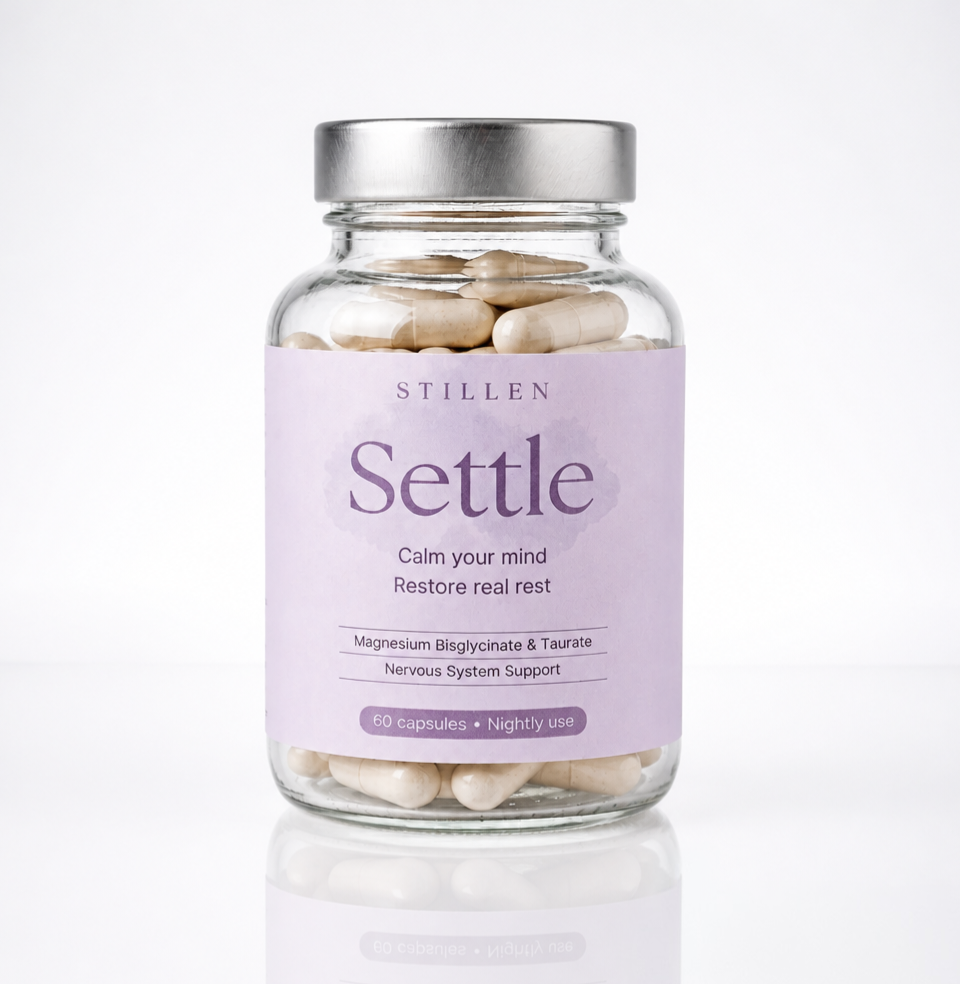
Settle, Stillen's magnesium blend, is formulated specifically for the nervous system, sleep, and everyday wellbeing in women who feel tired but wired. It is a considered option if you are starting here.
For women whose fatigue centres on broken sleep, racing thoughts, or that exhausted-but-unable-to-switch-off feeling, magnesium is one of the best-supported first steps available.
B Vitamins and Energy Metabolism: Useful but Nuanced

B vitamins have earned their "energy vitamins" reputation for good biological reasons. B12, B6, and folate all contribute to the cellular machinery that converts food into usable energy. B12 drives a key step in the Krebs cycle, which generates ATP (the body's fuel currency), and supports red blood cell production, delivering oxygen to your tissues. Folate works closely alongside B12 in several of these pathways. When any are low, the whole system slows.
The honest nuance: B vitamins support energy production when you are deficient. In women who already have adequate levels, the evidence for supplementation improving fatigue is considerably less convincing. A 2021 systematic review and meta-analysis (Markun et al., Nutrients) examined B12 supplementation effects on fatigue, cognitive function, and depressive symptoms, the evidence for benefit in non-deficient populations is not well-established. The promise that high-dose B vitamins will boost energy simply does not hold up for women who are already replete.
So who genuinely needs to pay attention? B12 deficiency affects close to 20% of adults over 60 in the UK. In the 35 to 55 demographic, those most at risk are women eating plant-based or low-meat diets (B12 is found almost exclusively in animal foods), those taking metformin or long-term proton pump inhibitors, and women with a history of autoimmune conditions such as autoimmune gastritis, which impairs the production of intrinsic factor, the protein needed to absorb B12.
B6 deserves specific mention in a hormonal context. Low B6 has been associated with low mood and fatigue; its relevance during hormonal transitions is a recognised area of clinical interest. For a fuller picture of how these nutrients connect to hormonal health, What the Evidence Says, Symptom by Symptom goes deeper.
Practical verdict: if your diet is low in animal products, or any of the risk factors above apply, a B-complex or targeted B12 supplement is a sensible, low-risk consideration. If none apply, save your money.
Vitamin D: Fatigue, Hormones, and the UK Deficiency Problem
Vitamin D behaves less like a typical vitamin and more like a hormone. It has receptors throughout the body, including in the brain, immune system, and muscle tissue, which is why low levels can show up as fatigue, low mood, and that heavy-limbed weakness that is hard to explain. It is not a simple deficiency story; it is systemic.
In the UK, the problem is structural. Public Health England recommends that all adults consider 10 micrograms daily during autumn and winter, because sunlight at our latitude simply cannot produce adequate levels for several months of the year. Women with darker skin tones, limited sun exposure, or predominantly indoor lifestyles are advised to supplement year-round. One in five adults in England may already have low levels, and many will not know it.
The evidence is honest rather than dramatic. Observational evidence consistently links low vitamin D with fatigue and low mood; correction of documented deficiency is recommended on that basis. The less convincing finding is that supplementing when levels are already adequate does not appear to produce the same benefit. The gain comes from fixing a genuine shortfall, not from adding more on top of sufficiency.
This matters because assuming your levels are fine, without checking, is a less reliable assumption in your 40s than it was in your 30s.
Practical verdict: a simple blood test to establish your baseline is genuinely worthwhile before committing to a long-term dose. Vitamin D is inexpensive, widely relevant for UK women in this demographic, and one of the clearest examples of a supplement that earns its place when deficiency exists.
Iron: The Frequently Overlooked Cause of Fatigue in Perimenopause
Iron is another frequently overlooked deficiency in this age group, and it is one that rarely gets the attention it deserves. If you have been exhausted in a way that is hard to explain and your periods have become heavier or less predictable, iron is worth putting on your radar.
Here is why it matters at this specific life stage. Perimenopause often brings irregular, heavier periods before they eventually stop. More blood lost each month means more iron lost, consistently, over months or years. This makes iron deficiency anaemia genuinely more common during the perimenopausal transition than many women, or their GPs, anticipate.
There is also a subtler problem that standard blood tests can miss. Full-blown anaemia will typically show up and get flagged. But your ferritin level, which reflects your iron stores, can sit within the laboratory's reference range while still being at the lower end, and some clinicians consider optimising ferritin, not just correcting outright deficiency, when evaluating fatigue. Many women feel significantly better when their ferritin is optimised, even if it was never technically deficient.
This is the one section of this article where the advice is unambiguous: do not supplement iron without testing first. Unlike magnesium or vitamin D, excess iron is not simply excreted and can accumulate in the body, which is why GP-guided testing before supplementation is important.
If you are focusing on dietary sources, including a range of iron-rich foods across your diet and seeking guidance from a registered dietitian on optimising absorption is worthwhile.
Practical verdict: ask your GP for a ferritin test alongside your full blood count if your fatigue is significant and your periods have been heavy. Iron deficiency is one of the most correctable causes of this kind of exhaustion, and it is consistently underidentified in this age group.
What the Evidence Does Not Support as Well: Supplements Worth Approaching With Caution
Testing and targeted supplementation make sense. Spending £40 on a beautifully packaged "perimenopause complex" because the marketing speaks directly to your exhaustion is a different matter entirely.
The supplement market for women in midlife is enormous, and not all of it earns its shelf space. Adaptogen blends (ashwagandha, rhodiola, maca, and similar herbs) are among the most heavily marketed ingredients for menopausal energy support. Some have plausible mechanisms, particularly around stress-response pathways. But plausible mechanism is not the same as proven outcome. A small trial in stressed adults, or a study on animals, does not translate to confirmed fatigue relief in perimenopausal women. That distinction matters when you are spending real money.
The same applies to proprietary "hormone balance" complexes, often combining multiple herbal extracts in doses too low to match the evidence that exists, if any exists at all. When you search for perimenopause supplements in the UK, the products that appear most prominently are not necessarily the ones with the strongest research behind them. They are the ones with the biggest marketing budgets.
A simple way to grade evidence yourself:
A randomised controlled trial (RCT) tests a supplement against a placebo in real people, which is meaningful
A single small RCT is suggestive but not conclusive
A systematic review pooling multiple large RCTs is the strongest level of evidence
An observational study or a mechanistic theory sits well below all of the above
The EFSA has evaluated a large number of health claims, with many rejected for insufficient evidence. For a deeper look at how nutrients interact with hormonal health more broadly, this guide to nutritional support for hormonal health is worth reading alongside this piece.
Scepticism here is not cynicism. It is the same standard of evidence Stillen applies to everything it recommends, including its own products. Being open to supplementation and expecting genuine proof are not in conflict; they belong together.
Can Vitamins Actually Balance Hormones? What That Phrase Really Means
That phrase "vitamins to balance hormones" is everywhere, and it sounds compelling when you are exhausted and looking for answers. It deserves an honest response.
No vitamin or mineral replaces oestrogen. Nothing you can take in capsule form overrides the hormonal transition your body is going through. That is simply not how these nutrients work, and any product implying otherwise is overpromising.
What some micronutrients can do is meaningfully different, and genuinely useful. B vitamins and magnesium are involved in multiple biochemical pathways that support the nervous system, energy production, and overall metabolic function. When these nutrients are depleted, as can happen during periods of hormonal change and chronic stress, restoring them can reduce the burden on a system already under pressure. Supporting those pathways is a legitimate, evidence-grounded goal. It just is not the same as "balancing" your hormones.
The distinction matters. "Supporting hormonal health" describes a real mechanism. "Balancing hormones" implies a direct hormonal effect that supplements cannot deliver, and it sets expectations that lead to disappointment and wasted money.
It is also worth naming what does directly modify hormone levels: HRT. That conversation sits outside the scope of this piece, but if your symptoms are significantly affecting your quality of life, it is worth raising with your GP, not as an alternative to nutritional strategies, but alongside them.
None of this is meant to deflate the value of micronutrients. Understanding what they can and cannot do does not make them less worth taking. It makes your choices more focused, and focused supplementation is far more likely to help than buying everything labelled "energy support" and hoping something works.
How to Prioritise: A Practical Framework for Spending and Effort
So now you have a clearer picture of what different supplements can and cannot do. The question that remains is a practical one: where do you actually start?
The simplest way to think about this is by symptom pattern first.
If your fatigue is wrapped up in poor sleep, racing thoughts, and that "tired but wired" feeling where you're exhausted but can't switch off, magnesium is the most logical first choice. It directly supports the nervous system pathways involved in sleep and stress regulation, and deficiency is genuinely common in UK women.
If your diet has been inconsistent, you eat little meat or fish, or you're over 50, B vitamins and vitamin D deserve attention next. Both have meaningful deficiency rates in this demographic, and both have plausible, evidence-grounded roles in energy metabolism.
If your periods have been heavy or irregular, test your iron before you take anything else. This is the one supplement where guessing carries real risk, and low ferritin is a correctable cause of fatigue that is frequently missed.
Before you spend anything, consider a baseline blood test. Vitamin D, ferritin, B12, and thyroid function together give you a genuinely useful picture of what is actually going on. Your GP can request these, or private testing services are widely available across the UK if you'd prefer not to wait.
If you are already taking a handful of supplements and feeling no different, the problem is usually one of two things: the wrong supplements for your specific pattern, or poorly absorbed forms that your body isn't actually using.
For most women, the three most evidence-supported starting points are magnesium (for sleep and nervous system support), vitamin D (given the documented prevalence of insufficiency in the UK), and B12 where deficiency risk exists. That is a short list by design. A targeted approach, grounded in your own symptoms and ideally your own test results, will serve you far better than a cabinet full of broadly marketed "energy" products.
And none of it works as well without the dietary foundation underneath it.
A Note for UK Women: What NHS and UK Guidelines Actually Say
One UK-specific context is worth keeping in mind as you put this together.
NHS guidance recommends that all UK adults consider taking a daily vitamin D supplement of 10 micrograms (400 IU) throughout autumn and winter. Between October and March, UK latitude means sunlight simply cannot trigger vitamin D synthesis in the skin. For women in their 40s and 50s, this baseline recommendation becomes more pressing: indoor lifestyles, the hormonal changes of perimenopause, and reduced skin synthesis with age can all compound the shortfall, making year-round supplementation worth discussing with your GP.
UK dietary reference values for nutrients like magnesium, iron, and B12 represent the minimum intake needed to prevent deficiency in the general population. They are minimum protective values for the general population rather than optimisation targets for women experiencing significant hormonal change. Meeting the RNI for magnesium does not automatically mean you have enough to support a nervous system under hormonal pressure.
Many women in this age group have never raised nutritional strategies with their GP in the context of perimenopause. That conversation is worth having. Asking your GP about testing or requesting a referral to a registered dietitian are both legitimate steps, not an overreaction.
On supplement quality: the UK market is not uniformly regulated for the quality or bioavailability of what is inside the capsule. When choosing perimenopause supplements in the UK, look for products with third-party testing, transparent ingredient sourcing, and forms of nutrients that are well-absorbed rather than simply cheap to manufacture.
Finally, this piece is educational, not clinical advice. If you have a complex health history or take regular medication, nutrient and drug interactions are real, and personalised guidance from a healthcare professional matters.
What This All Means for You
So, what does all of this actually mean for you?
It means the exhaustion you feel is real, it is biological, and it is not a personal failing. It also means there are specific, evidence-backed options worth trying. But which ones help depends on your individual pattern, not a one-size-fits-all supplement list.
The symptom-pattern framework in the prioritisation section above is the most practical starting point.
None of this happens overnight. The clinical research reflects that, with meaningful changes typically taking weeks to months rather than days. That is not a caveat; it is an honest expectation.
The goal here was never to overwhelm you with options. It was to help you feel more like yourself again, with fewer guesses and more confidence. That is what the evidence, used well, can actually offer.
Conclusion
The approach this piece sets out, food first, then targeted supplements matched to your pattern, is a practical framework you can act on today.
There is no need to buy everything at once. Start with what matches your pattern, test where you can, and give interventions the weeks they need to work.
If you take one thing from this post, let it be this: clarity beats volume. You do not need more supplements. You need the right ones, chosen for the right reasons.
Use the framework here as your starting point, and begin reclaiming your energy today.
Frequently Asked Questions
Why does menopausal fatigue feel so different from regular tiredness?
Menopausal fatigue is different because falling oestrogen and progesterone directly disrupt your brain's sleep architecture, creating a paradoxical state of being "tired but wired." Unlike ordinary tiredness, your nervous system stays in a low-grade alert state even when your body desperately needs rest. This means you can sleep eight hours but wake feeling unrefreshed, and your brain won't switch off despite profound exhaustion. This happens simultaneously because of poor sleep, HPA axis dysregulation, nutrient depletion, and thyroid changes—rarely just one cause.
Which supplements have the strongest evidence for menopausal fatigue?
The three most evidence-supported starting points are: (1) Magnesium—for sleep and nervous system support, addressing both sleep disruption and the "tired but wired" pattern; (2) Vitamin D—given documented insufficiency in UK women, though testing is recommended first; and (3) B12—specifically if you have deficiency risk factors like a plant-based diet, use metformin, or have autoimmune conditions. The key is matching supplements to your specific symptom pattern rather than taking everything marketed for "energy support."
Should I take supplements without getting blood tests first?
Testing should be your priority before spending money on most supplements. A baseline blood test measuring vitamin D, ferritin, B12, and thyroid function gives you a clear picture of what's actually happening rather than guessing. This is especially important for iron—never supplement iron without testing first, as excess iron can accumulate in your body unlike other nutrients. Your GP can request these tests, or private testing services are available across the UK. This targeted approach based on your actual results will be far more effective than a cabinet full of broadly marketed products.
Can vitamins actually balance my hormones during perimenopause?
No vitamin or mineral can replace oestrogen or directly "balance" your hormones—any product claiming this is overpromising. However, micronutrients like magnesium and B vitamins can meaningfully support your nervous system, energy production, and metabolic function when depleted. What they do is reduce the burden on a system already under hormonal pressure by supporting biochemical pathways, rather than overriding your hormonal transition. The distinction matters: "supporting hormonal health" through supplementation is real and evidence-grounded, while "balancing hormones" sets false expectations.
What should I prioritise first—diet or supplements?
Diet should come first. Research shows that a Mediterranean diet pattern—built around vegetables, wholegrain, legumes, oily fish, nuts, and olive oil—is the primary evidence-based intervention for menopausal health outcomes. No supplement compensates for a chronically poor diet, as micronutrients need co-factors, fibre, and nutrient synergy from whole foods to be properly absorbed and used. Supplements work best when filling genuine gaps in an otherwise reasonable diet. Start with consistent, small dietary shifts before or alongside any supplementation for the best results.